SEO for real estate agents in South Florida
Buyers search before they call. Be the agent they find. We get real estate agents found on Google and recommended by AI assistants, then turn those searches into booked jobs.
Thanks. We'll check where you stand on Google and across AI assistants, then reply within one business day. If it's urgent, call 754-306-0444.
Buyers search before they call. Be the agent they find. The calls are going to whoever shows up first.
Here's the short version: when a South Florida buyer or seller searches for an agent, or asks ChatGPT for a good one in their neighborhood, someone has to show up, and right now it probably isn't you. We do real estate SEO for realtors here in South Florida: getting you into the Google map pack, cited by AI assistants like ChatGPT, and ranking for the searches that turn into showings and signed listings. No contracts, no jargon, just being the agent they find first.
The real reasons you're not showing up
Your Google Business Profile is thin or unclaimed, so you never surface in the local map pack.
A single template page gives Google and buyers no reason to pick you over the next agent.
Established agents own the neighborhood searches while your name never even loads.
Season turnover sends buyers searching, and you are invisible right when demand peaks.
Thin or scattered reviews make buyers hesitate before they ever pick up the phone.
When buyers ask ChatGPT for a local agent, there is no clear page naming you.
Built to get realtors and agents more calls
Every engagement starts with your Google Business Profile. It is where the calls come from, and the citations AI pulls from.
- ✓Google Business Profile set up for the calls real estate agents actually get
- ✓Service pages for the work you want more of
- ✓City pages for the areas you actually cover
- ✓Answer-ready content for the questions customers ask AI
- ✓A fast site with the phone number impossible to miss
- ✓Review request system so new jobs bring new reviews
- ✓Schema markup so Google and AI understand your services
- ✓Plain-English monthly reporting on calls and rankings
From broken to found
Most sites we take over are slow, generic, and full of the wrong information. Here is the kind of turnaround we build: the old broken site on the left, the FoundRank.ai version on the right.
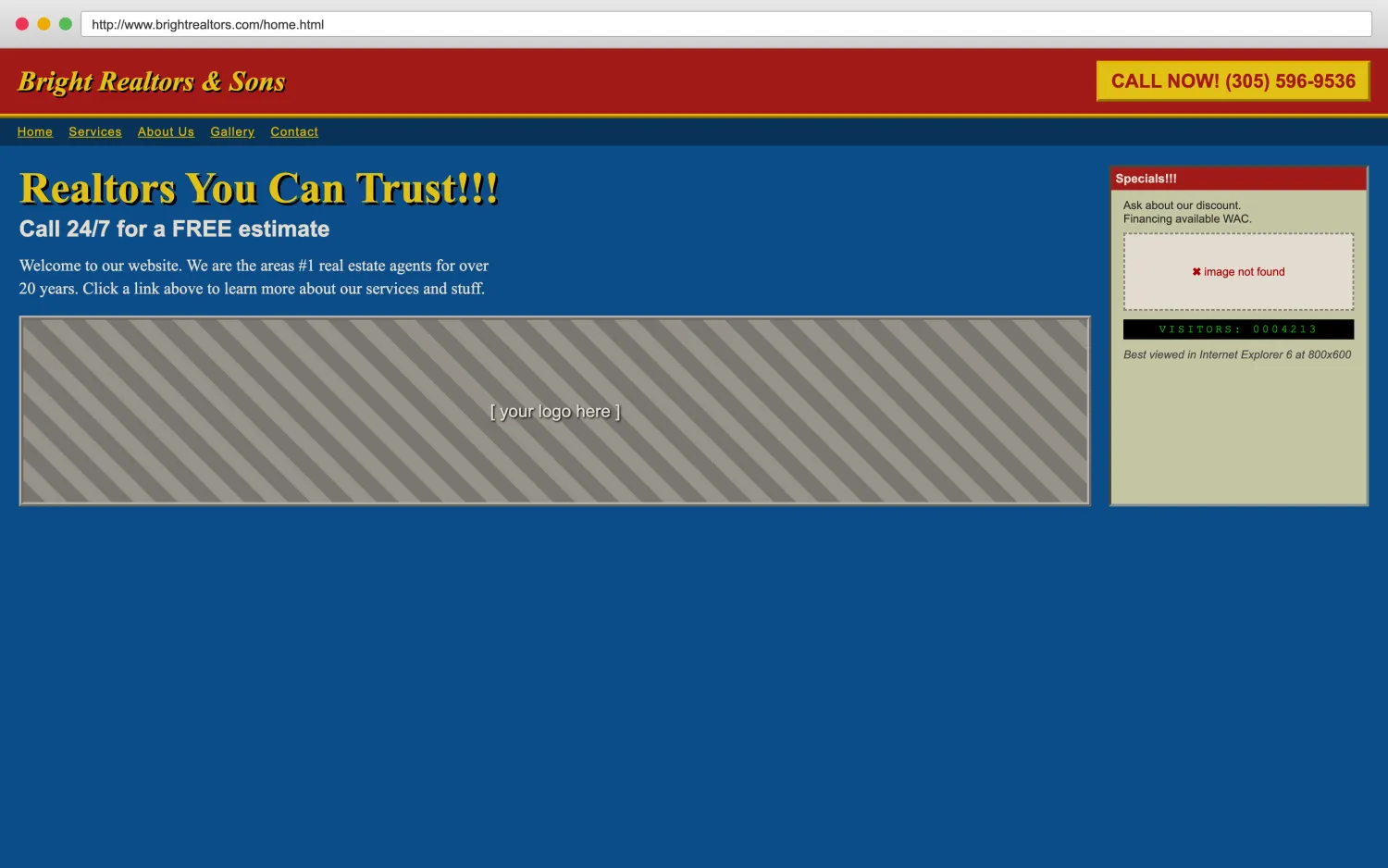
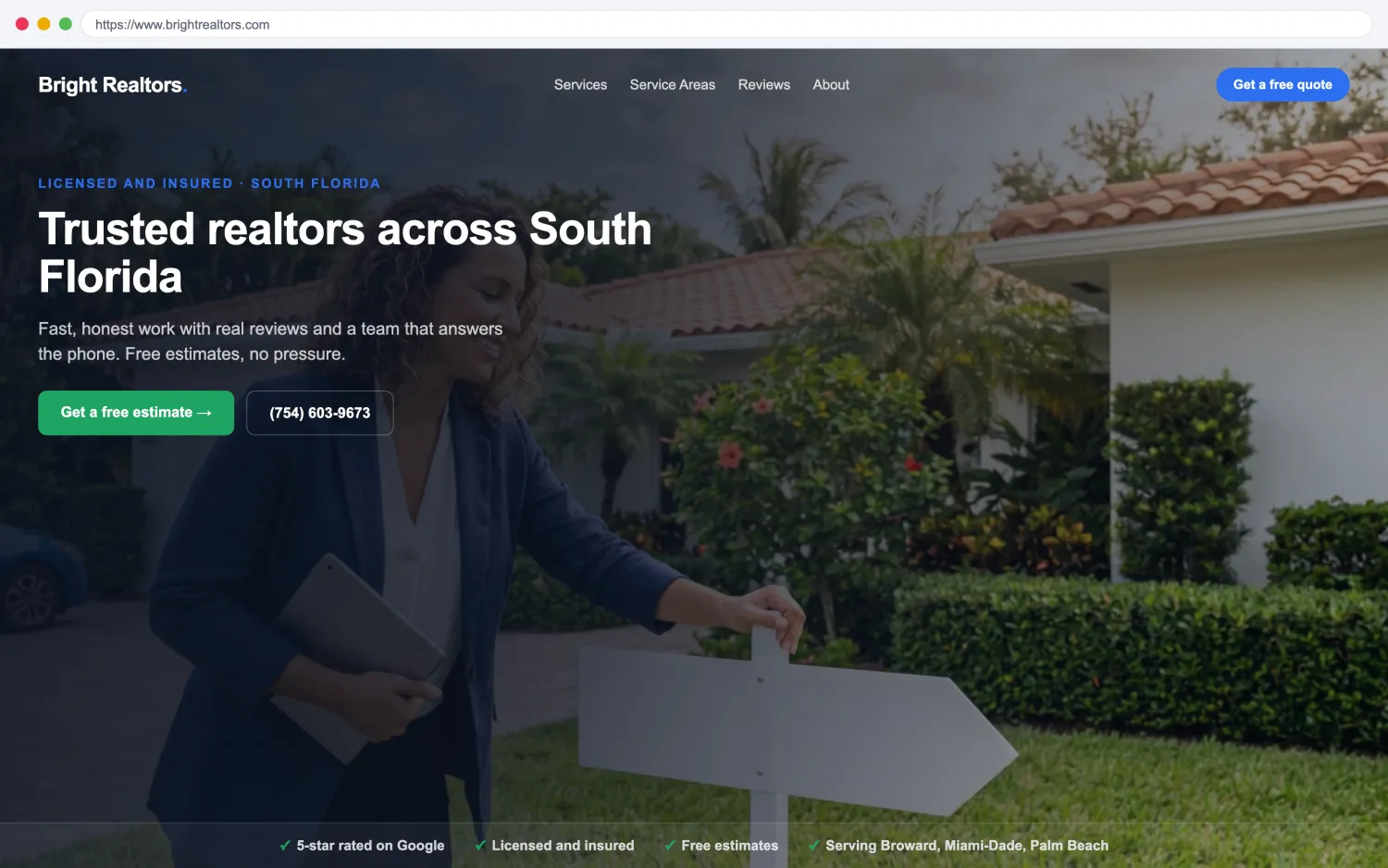
Illustrative example of the kind of website transformation we build, not a specific client site.
What "found" looks like
Pulled from Google Search Console and Google Analytics for real builds. Different trades, same playbook.
Google search impressions in 90 days, up from 352 the 90 days before.
- ✓Google clicks up from 3 to 52 over the same 90 days
- ✓109 searches now reach Google's top 10, 37 of them the top 3
- ✓#2 on Perplexity and #1 on Google's Gemini when people ask for local window companies
sessions, from 661 to 1,352.
- ✓New visitors up 153%, from 434 to 1,100
- ✓Conversions went from 0 to 20
- ✓Average Google ranking improved from position 16.6 to 13.1
- ✓#1 or #2 for every version of the church's name people search
Google search impressions, from a standing start.
- ✓0 to 170 website visits, 154 of them new
- ✓Now showing for bathroom remodel searches across Weston, Boca Raton, Pembroke Pines, and Plantation
"FoundRank.ai is the best thing to have in my business. I've increased my sales by over 70%, and now I have my time back."
The searches that ring the phone
We research the high-intent questions your customers actually type and ask AI, then build the pages and profile signals that answer them.
The full picture for realtors and agents
Buyers do not walk into an office and ask an agent for a recommendation anymore. They search on their phone, months before they ever talk to a person, and they form an opinion about who the local expert is before that agent even knows the buyer exists. FoundRank.ai builds real estate agents and small brokerages into the names that show up in that search, on Google and in the answers AI tools give when someone asks where to buy in South Florida.
How buyers and sellers actually search today
Real estate search starts broad and gets specific fast. Someone new to the area searches 'best realtor in Fort Lauderdale' or 'top real estate agent near me' before they know a single neighborhood name. A few weeks later the same person is searching 'condos for sale in [neighborhood] with low HOA' or 'homes near good schools in Boca Raton,' because by then they have opinions about commute, flood zones, and insurance costs. Sellers search differently again, typing 'how much is my house worth' or 'best time to sell a house in South Florida' long before they call anyone.
A growing share of that research now happens inside an AI assistant instead of a search results page. Someone asks ChatGPT or Google's AI Overview 'what's it like living in [city], Florida' or 'is now a good time to buy a condo in South Florida' and gets a written answer that may name a market expert, a neighborhood guide, or a local team. An agent with no content answering those exact questions is left out of that answer entirely, no matter how many deals they have closed. Ranking in the map pack and being cited inside an AI answer are two different fights now, and most agent websites are built to compete in neither one.
Trust research is heavier in this trade than almost any other. Buying or selling a home is the largest transaction most people ever make, so before anyone calls, they search the agent's name plus 'reviews,' check how long they have worked a specific area, and compare who seems to actually know the neighborhood versus who just has a nice headshot. A profile that looks thin, generic, or stale loses that comparison even when the agent behind it is excellent.
The real problems agents run into online
Most agent websites are built once, at the brokerage's template default, and never touched again. A homepage with a headshot, a search widget pulling from the MLS, and a bio page does not answer 'what neighborhoods in Delray Beach are best for families' or 'is Wilton Manors a good investment,' and it gives Google and AI tools nothing specific to point to. Meanwhile every other agent in the same office is often running the exact same template, which means real estate search results in South Florida are frequently a wall of interchangeable sites competing only on ad spend.
Reviews and reputation move slower in real estate than in most trades, since a single client only transacts once every few years, and that creates a real gap. An agent doing dozens of deals a year can still have a thin Google Business Profile with a handful of old reviews, because closing a deal does not automatically translate into a review request the way a service call does. Competitors who systematically ask for reviews after every closing pull ahead in the map pack even with fewer total transactions.
South Florida adds its own layer that generic, franchise-provided content never addresses. Buyers here ask about flood zones, windstorm and hurricane insurance costs, HOA and condo association special assessments after the Surfside building law changes, and whether a building has passed its milestone inspection. An agent's site that cannot speak to 'what is a milestone inspection' or 'condo insurance going up in Florida' in plain language loses that buyer to whichever agent's content actually answers the question.
Seasonal demand: snowbird season and the turnover rush
South Florida real estate search runs on a snowbird calendar as much as a national one. Searches for 'condos for sale near the beach' and 'homes for sale in [city] Florida' climb every fall as northern buyers start planning their move south, peak through winter while snowbirds are physically in town touring properties, and stay elevated into spring as those visits turn into offers. An agent who is not visible in search and the map pack by November has missed the window when out-of-state buyers are actively deciding who to call.
There is a second, steadier driver layered on top: year-round relocation and turnover from people moving to Florida for work, retirement, or no state income tax, plus the seasonal rental turnover that keeps 'best neighborhoods to live in [city]' and similar searches active every month of the year. FoundRank.ai builds content and Google Business Profile activity to match both curves, so an agent is already established and visible before the snowbird rush hits, not scrambling to build a presence in the middle of peak season.
Getting into the map pack and cited by AI
The map pack for 'realtor near me' or 'real estate agent in [city]' is won with a fully built out Google Business Profile, consistent name and contact information across every real estate directory and brokerage listing, and a steady flow of recent reviews naming specific transactions and neighborhoods. FoundRank.ai audits the profile, fixes listing inconsistencies that quietly cap rankings, and sets up a system so review requests go out after every closing instead of occasionally when someone remembers.
Getting cited inside AI answers takes different content entirely: neighborhood guides that actually answer 'is [neighborhood] good for families' or 'what's the average price per square foot in [city],' pages built around real buyer and seller questions, and the schema markup that tells Google and AI models exactly what a page covers and who wrote it. FoundRank.ai builds location-specific pages by city and neighborhood, FAQ content pulled from real client questions, and structured data that makes an agent's site a source AI tools are comfortable citing by name. The two efforts feed each other, since the same local authority signals that lift a map pack ranking are what make an AI assistant willing to name an agent in its answer.
What our real estate SEO services include
Every engagement starts with a full audit: Google Business Profile health, current map pack position for the agent's core cities and neighborhoods, site speed on mobile, and an honest look at what content exists versus what buyers and sellers are actually searching. Our real estate agent SEO work covers the rest: FoundRank.ai builds the missing neighborhood and city pages, fixes technical problems holding the site back, and puts in place the schema markup and review system that feed both traditional search and AI answers.
There are no long-term contracts. Work is scoped, delivered, and reported on in plain language, month over month, so an agent always knows what was done and what changed because of it. The goal is simple: when someone starts searching for a home in South Florida, that agent is the name Google surfaces and the name an AI assistant mentions, long before the buyer ever picks up the phone.
Realtors and agents across South Florida
A service-area business, so we come to you. Broward, Miami-Dade, and Palm Beach.
Trades that share realtors and agents customers
The same homeowners search for these services, often in the same week. Each one gets its own playbook.
The honest part
Why do buyers find every other agent on Google before they find me?
Here's the short version: when a South Florida buyer or seller searches for an agent, or asks ChatGPT for a good one in their neighborhood, someone has to show up, and right now it probably isn't you. We do real estate SEO for realtors here in South Florida: getting you into the Google map pack, cited by AI assistants like ChatGPT, and ranking for the searches that turn into showings and signed listings. No contracts, no jargon, just being the agent they find first.
I already rank for my own name. Why don't I show up for 'realtor near me'?
Ranking for your own name only proves Google can find your listing, not that Google trusts you for a competitive term like 'realtor near me.' That trust comes from Google Business Profile completeness, review volume and recency, consistent listings across real estate directories, and whether your site actually proves local expertise in specific neighborhoods. FoundRank.ai audits all of it and fixes the gaps in priority order.
My brokerage already gave me a website template. Isn't that enough?
A brokerage template gets you online, but it rarely gets you found, since most agents in the same office are running the same template with the same generic content. This is where SEO for real estate agents actually differs from what most real estate SEO companies hand you: the agent-specific content that moves the needle. Neighborhood pages, real answers to buyer and seller questions, and a Google Business Profile built around your actual transactions, not a shared brand shell.
How do I get more reviews when clients only transact once every few years?
The fix is a consistent ask, not a bigger client base. Reviews should go out right after every closing while the experience is fresh, every time, not only when it crosses your mind. FoundRank.ai sets up that system so your review count and recency keep climbing steadily instead of sitting flat between deals.
Should I have separate pages for each neighborhood I work, or one general service area page?
Separate pages perform better. Someone searching 'homes for sale in Wilton Manors' and someone searching 'best neighborhoods in Delray Beach' have different questions and different intent, and one general page cannot answer either specifically. Distinct neighborhood pages also give Google and AI tools clearer, more specific content to match against those exact searches.
Ready for more realtors and agents calls?
Tell us your business and top service area. We will show you exactly where you stand on Google and across AI today, free, and reply within a day.